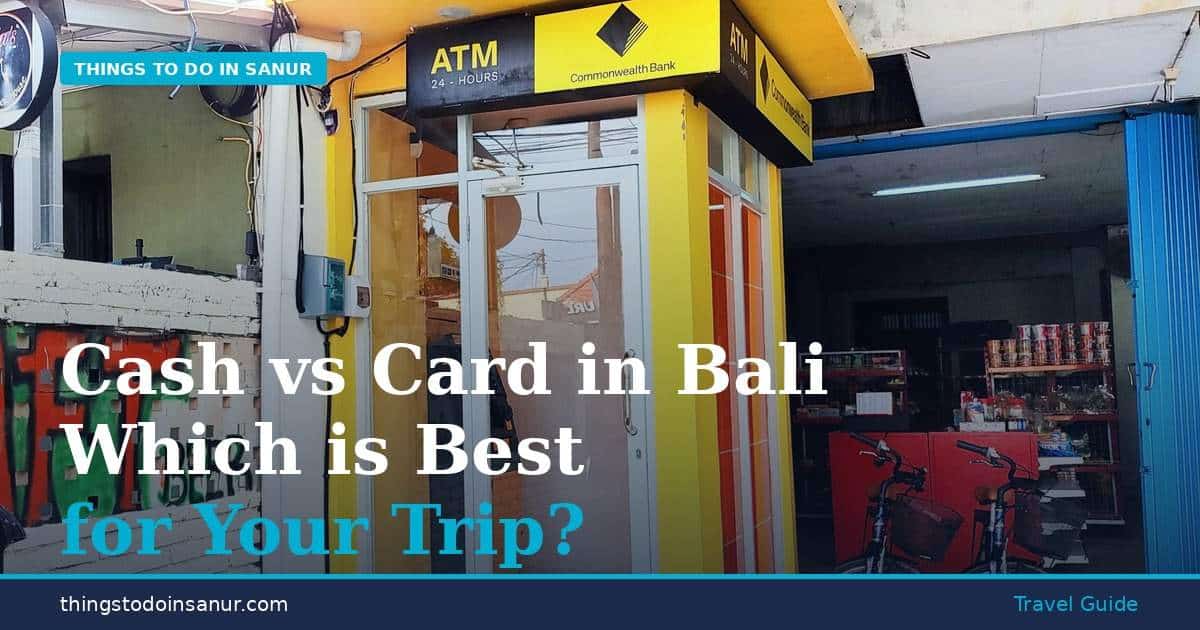
Cash vs card in Bali — it is one of the most hotly debated topics among travellers heading to Indonesia. You will find opposing opinions everywhere. Some swear by cash only, others refuse to carry it. We have used both on multiple trips and this guide covers the pros and cons of each so you can decide what works best for your trip to Sanur Bali.
What is the currency in Bali?
The official currency of Indonesia is the Rupiah. Despite what you may hear, we have never personally seen Australian dollars or USD accepted in shops in Bali — always use local currency. The number of zeros takes some getting used to but once you adjust it becomes second nature.

Cash vs card in Bali — our honest opinion
For us, a mix of both is the best approach. We are budget travellers and find that when we put things on a card in Bali, spending can get out of hand quickly. Having cash makes it easier to track what we are spending each day. That said, having a card as backup has saved us more than once.
Using cash in Bali
One way to pay in Bali is to bring cash from home and exchange it into Rupiah at a money changer. Smaller shops and warungs often only take cash — and smaller notes at that. It pays to keep a good supply of 20,000 and 50,000 IDR notes.
Pros of using cash in Bali
- You always know exactly how much you have left
- You can set a daily limit and only take that amount out with you
- No international transaction fees
- Works everywhere — markets, warungs, small shops, beach vendors
Cons of taking cash to Bali
- You need to find an official money exchange to avoid being ripped off
- Carrying a large amount of cash around is a security risk
- Keeping it safe at your Sanur accommodation until you need it
- Running short at dinner and needing to find an exchange late at night
- Would you carry large amounts of cash around at home?
Using a card in Bali
Cards are widely accepted at larger restaurants, hotels and shops in Sanur. Having a card as a backup is genuinely useful — we have been out at night with friends who had to return to their hotel to get more cash. A card kept that situation from becoming a bigger hassle.

Pros of using a card in Bali
- No need to find a money exchange
- No risk of running out of cash mid-meal
- Allows spontaneous purchases and flexibility
- Easier to track spending through your banking app
Cons of using a card in Bali
- Cards can be skimmed — a real issue if it is your only payment method
- Some stores charge 3% to 20% surcharge for card payments
- Some places do not accept cards at all
- Banks can put a hold on your card if you haven’t notified them of overseas travel
- Spending can get out of control if you are not paying attention
Always notify your bank before travelling to Bali. Banks regularly put holds on accounts flagged for overseas use — if a card is your only payment method this can leave you stuck. Wise, Revolut and some ING accounts offer low or zero fees on overseas withdrawals and are worth setting up before you leave.
Using a mix of cash and card in Bali
This is what works best for us. We usually withdraw a week’s worth of cash and divide it into daily amounts in ziplock bags — one bag per day. We keep smaller notes from previous days topped up to handle warungs, markets and beach vendors. In order to get a weeks worth of money we had to make a few ATM withdrawals at the same time. The card stays as backup for restaurants, hotels and emergencies.
Pros of using a mix of cash and card
- If you run out of cash, the card covers you — transfer the amount back to your daily budget
- You can pop into any warung or beach bar without worrying about what you have on you
- If your card gets skimmed, you have cash to get you through while you sort it out
Cons of using a mix
- You need to find an official exchange and a suitable ATM
- You may pay transaction fees on both ends if withdrawing and transferring
A mix of cash and card is the best way to go. You will be covered in almost every situation and won’t have any embarrassing moments being unable to pay for something. Cash for the daily stuff, card for the bigger purchases and emergencies.
How to find an official money exchange in Bali
This is the most important piece of advice in this article. Bali has a well-known problem with dodgy money changers targeting tourists — knowing how to spot an official one can save you a lot of money.
Signs of a legitimate money exchange:
- Large shopfront, usually with a security guard out the front
- A receptionist who confirms the exchange rate and the amount before proceeding
- Your money is taken to a back room to be counted and exchanged
- The Rupiah is counted in front of you and a receipt is provided
- They will not touch the money again once it is in your hands
Warning signs of an unofficial exchange:
- Exchange rate on the board looks too good to be true — it is
- They pay out in 50,000 IDR notes and count multiple times, skimming notes back as they go
- A small booth in a shop that looks temporary or makeshift
If you feel you have been given the wrong amount at a money exchange, always question them about it. If they won’t admit it, tell them you will alert the local police. This will usually get some sort of result. Do not leave the area until you have counted the money in full — once you walk out, it is very hard to dispute.

Cash vs card in Bali — our top tips
Always have a backup card. Bank holds on overseas accounts are common and if a card is your only source of money it can cause real problems — especially on weekends when your bank may be harder to reach.
Look for a card with minimal overseas withdrawal fees before you leave. Wise, Revolut and some ING accounts are well regarded for this among Australian travellers to Bali.
Don’t carry large amounts of cash on your person. If you wouldn’t do it at home, don’t do it on holiday.
A small travel safe can help keep your cash secure in your room if you are not comfortable using the hotel safe. We have cable-tied a suitcase to a bolted-down desk with a combination lock when we didn’t trust the room safe in a different country — low tech but effective.
If you are relying primarily on card, keep track of your balance and avoid putting everything on credit. Coming home from a great holiday to a large credit card bill is a quick way to undo the good feeling of the trip.
ATM fees and withdrawal limits in Bali
Most ATMs in Bali charge a flat fee per withdrawal regardless of the amount — typically between 50,000 and 75,000 IDR per transaction. On top of that, your own bank may charge an overseas withdrawal fee. This means small, frequent withdrawals are expensive. Withdraw larger amounts less often to minimise fees.
Most ATMs in Bali have a per-transaction withdrawal limit of around 3,000,000 IDR. BCA and BNI ATMs are generally the most reliable for foreign cards in Sanur. Avoid standalone ATMs in small shops or tourist areas — these are the most common targets for card skimming.
Do not get money out at the airport on arrival — the exchange rates and ATM fees at Nguyen Rai Airport are significantly worse than in Sanur. Bring enough AUD or USD to cover your first day, then use a reputable money changer or ATM in town once you have settled in.
Best cards to use in Bali — Wise vs Revolut vs ING
If you are heading to Bali, it is worth setting up a low-fee travel card before you leave. Standard Australian bank cards typically charge 2-3% on every overseas transaction plus a flat ATM withdrawal fee — that adds up quickly over a two-week trip. Here is how the main options compare:
Wise
Wise converts at the mid-market exchange rate with a small transparent fee — usually around 0.4-0.6% on currency conversion. You get two free ATM withdrawals per month up to a combined limit before fees kick in.
The best way to use Wise in Bali is to convert your AUD into Indonesian Rupiah before you leave Australia — do this in the Wise app while you are still at home. You lock in the exchange rate at the time of conversion and avoid any currency conversion fees when spending in Bali. Do not leave your balance in AUD and let it convert at the point of purchase.
A few important things to know when using Wise at ATMs in Bali:
- Always choose local currency (IDR) when the ATM asks — never select your home currency. Choosing AUD or USD triggers Currency Conversion which adds hidden fees on top of everything else.
- Independent ATM operators charge their own fees on top of anything Wise charges — this is the ATM owner’s fee, not Wise’s, and Wise cannot waive it. Stick to bank ATMs like BCA and BNI where possible.
- After your free monthly limit, Wise charges 1.50 AUD plus 1.75% of the amount over 350 AUD (or 1.50 USD plus 2% above 100 USD for USD accounts). Stay within your free allowance by withdrawing the maximum 3,000,000 IDR in fewer transactions.
Revolut
Revolut offers fee-free currency exchange up to a monthly limit on the free plan, with ATM withdrawals free up to a set amount per month. The exchange rate is very competitive during weekday trading hours — The exchange rate is very competitive but can vary from day to day.
Same advice applies as Wise — convert your AUD to Rupiah in the Revolut app before you travel. This locks in the exchange rate and means you are spending from a Rupiah balance rather than converting on the fly in Bali, which can attract worse rates particularly over weekends.
As with Wise, always choose local currency (IDR) when the ATM prompts you — selecting your home currency triggers Currency Conversion and adds hidden fees. Independent ATM operators also charge their own fees on top of anything Revolut charges — this is the ATM owner’s fee, not Revolut’s, and Revolut cannot waive it. Stick to bank ATMs like BCA and BNI where possible to minimise these charges.
ING Orange Everyday
ING rebates all international ATM fees and charges zero foreign transaction fees — as long as you meet the monthly eligibility criteria (deposit your salary and make 5+ purchases each month). For Australian travellers who already use ING as their main account it is often the simplest option with no separate app to manage.
Set up whichever travel card you choose at least two weeks before you leave Australia. Wise and Revolut both require identity verification which can take several days. ING requires you to meet deposit criteria in the month before travel. Don’t leave it until the night before you fly.
Can you tap and pay in Bali?
Yes — and more widely than most people expect. In our experience tap-to-pay works at the majority of restaurants, cafes, hotels, supermarkets and larger shops in Sanur. It has become far more common in recent years and we now rarely have an issue using contactless payments at the places we visit regularly.
The main exceptions are small warungs, street food vendors, market stalls and some budget accommodation — these are still cash only. But if you are eating at a sit-down cafe or restaurant in Sanur, there is a good chance tap will work.
QR code payments via the Indonesian QRIS system are also increasingly common at mid-range cafes and restaurants. You will see QR codes on the counter or on small table signs. Some Wise and Revolut cards support QRIS payments through their apps — worth checking before you go.
FAQs — cash vs card in Bali
Should I use cash or card in Bali?
A mix of both is the best approach for most travellers. Use cash for smaller purchases — warungs, markets, street food and beach vendors — and keep a card for larger restaurants, hotels and as a backup. This covers you in almost every situation without carrying excessive amounts of cash.
Can you use credit cards in Bali?
Yes — credit and debit cards are widely accepted at larger hotels, restaurants and shops in Bali. However many smaller shops, warungs, markets and street vendors are cash only. Be aware that some businesses charge a 3% to 20% surcharge for card payments, so always ask before paying.
How much cash do I need in Bali?
It depends on your travel style but a reasonable daily cash budget for a mid-range traveller in Sanur is around 300,000 to 500,000 IDR per person for food and small purchases, on top of pre-paid accommodation. Withdraw a week’s worth and divide it into daily amounts to help manage your spending.
Is it safe to use a card in Bali?
Generally yes, but card skimming does occur. Use ATMs attached to banks or large reputable hotels rather than standalone machines. Always cover your PIN when entering it. Notify your bank before travelling and carry a backup card in case your primary one is compromised or blocked.
What is the best card to use in Bali?
For Australian travellers, Wise, Revolut and some ING accounts are popular choices for low or zero overseas withdrawal and transaction fees. These can save a significant amount over a two-week trip compared to standard bank cards which charge 3% or more on every transaction.
Do you need cash for Bali markets?
Yes — Bali markets including the Sanur markets are almost exclusively cash only. Always carry small denomination Rupiah notes when heading to a market. 10,000, 20,000 and 50,000 IDR notes are most useful for market shopping and street food.
Can you tap and pay in Bali?
Yes — tap-to-pay works at the majority of restaurants, cafes, hotels and larger shops in Sanur in our experience. It is far more widely available than most travel guides suggest. The main exceptions are small warungs, street food vendors and market stalls which are still cash only. Always carry some cash as backup but you will likely find tap works at most sit-down places.
Should I bring cash from Australia to exchange in Bali?
You can — but avoid exchanging at the airport on arrival as rates there are significantly worse than in town. Bring enough AUD or USD to cover your first day, then use a reputable money changer or bank ATM in Sanur once you have settled in. AUD and USD are the most commonly accepted foreign currencies at Bali money changers.
How much do Bali ATMs charge per withdrawal?
Most ATMs in Bali charge a flat fee of around 50,000 to 75,000 IDR per withdrawal regardless of the amount. The maximum withdrawal limit is typically 3,000,000 IDR per transaction. BCA and BNI bank ATMs are the most reliable for foreign cards. Withdraw larger amounts less often to keep fees down.
Don’t forget travel insurance for Bali
Get a quote with Cover-More — trusted by Australian travellers
Plan your trip to Sanur
Everything you need in one place